3.30.2010

Lifestyle Design


For many years now, Ive been experimenting with various aspects of lifestyle design. The more you learn about different places/cultures in the world, the more you uncover a vast array of different lifestyles, none "better" than the other. To my knowledge no one has found the only way or path to happiness.

The other day I came across a short story which summarizes why working 9-5 (wage slavery) for 40 years is overrated. This lifestyle places people into the category of deferred lifers, which we are unconsciously funneled into from our first day in organized education. Other categories consist of the working rich, the wealth seekers, dream jobbers, and finally lifestyle designers. The later category of people essentially ask, “why wait until you’re rich or retired to live the life you really want to live?” They start with the concept of an ideal lifestyle and work backwards to plan a career that will suit that lifestyle.

My wife & I are tossing around the idea of working 1/2 the year and more importantly not working 1/2 the year. This would enable us to pursue dreams not based upon money, stay tuned to see how this meshes with the modern wage system.

"Don't let your dreams be dreams." - Jack Johnson (Hawaiian singer/songwriter)


The Story of the Mexican Fisherman

by Henrik Edberg.

An American businessman was standing at the pier of a small coastal Mexican village when a small boat with just one fisherman docked. Inside the small boat were several large yellowfin tuna. The American complimented the Mexican on the quality of his fish.

“How long it took you to catch them?” The American asked.

“Only a little while.” The Mexican replied.

“Why don’t you stay out longer and catch more fish?” The American then asked.

“I have enough to support my family’s immediate needs.” The Mexican said.

“But,” The American then asked, “What do you do with the rest of your time?”

The Mexican fisherman said, “I sleep late, fish a little, play with my children, take a siesta with my wife, Maria, stroll into the village each evening where I sip wine and play guitar with my amigos, I have a full and busy life, senor.”

The American scoffed, “I am a Harvard MBA and could help you. You should spend more time fishing and with the proceeds you buy a bigger boat, and with the proceeds from the bigger boat you could buy several boats, eventually you would have a fleet of fishing boats.”

“Instead of selling your catch to a middleman you would sell directly to the consumers, eventually opening your own can factory. You would control the product, processing and distribution. You would need to leave this small coastal fishing village and move to Mexico City, then LA and eventually NYC where you will run your expanding enterprise.”

The Mexican fisherman asked, “But senor, how long will this all take?”

To which the American replied, “15-20 years.”

“But what then, senor?”

The American laughed and said, “That’s the best part. When the time is right you would announce an IPO (Initial Public Offering) and sell your company stock to the public and become very rich, you would make millions.”

“Millions, senor? Then what?”

The American said slowly, “Then you would retire. Move to a small coastal fishing village where you would sleep late, fish a little, play with your kids, take a siesta with your wife, stroll to the village in the evenings where you could sip wine and play your guitar with your amigos…”

3.02.2010

Tramping in Fiordland


Imagine a land of snow-capped mountains, steep-sided fiords, deep lakes, and unbroken forests. This wild and remote region, consisting of 27,000 km2 of unbridled space, is known as Fiordland, and lies in the southwestern portion of the south island in New Zealand. Together with Mt Aoraki NP, Mt Aspiring NP, and Westland NP, they form Te Wāhipounamu (Maori for place of greenstone). In 1990 Unesco recognized the extraordinary beauty of this area and listed it as a world heritage site, which is thought to contain the original flora and fauna present in Gondwanaland (precursor super continent).


The indigenous people of New Zealand, known as Maori (meaning natural), are a Polynesian people thought to have originally migrated to New Zealand in the 1300's and developed a distinctive culture and language. Following the theft of their lands by European settlers in the 1800's, today the Maori (like virtually all indigenous people) have been subjugated to the lower class of society with all vices associated. For example, they represent 14% of total population, yet 50% of prison population.


Last year, we explored on the north island, the Whanganui River NP, the old Maori trading route which flows from the northern slopes of Mt. Tongariro. This expedition would retrace many of the "greenstone" trails, the Maori carved through the forest in order to collect this revered gemstone. The southern island was not heavily populated by the Maori, yet used it for seasonal hunting grounds and greenstone collection. Pounamu (a greenstone) is a form of nephrite jade, generally found in rivers as nondescript boulders and stones which are difficult to identify without cutting them open. These gems were highly prized by the Maori and they undertook perilous expeditions to collect these mainly for tools, ornaments, and weapons.


The story begins with the author and his Swedish colleague traveling along the southern alps, across tranquil pasture lands, scenic lakes, under the shadow of Mt Aoraki. It was to be a 10 day road trip, consisting of a figure 8 through the National Parks of the South Island. Our first stop was the highest mountain in New Zealand, Mt Aoraki (or Mt Cook), standing at 12,31ft. This eminent prominence is draped by 4 photogenic glaciers, which deposit glacial till in the lakes, creating emerald green heaven. I prefer the Maori name for many reasons, mainly because it means cloud piercer (which it does) versus the European name, which is named after the infamous Captain James Cook who never laid eyes on the Mountain. Geography is rife with the names of old white men, who never laid eyes on the things they were named after.


Following three flights (including 1 red-eye), 4 hours waiting for my traveling companion at the Christchurch airport, and 5 hours en route to Mt Aoraki- setting up camp and calling it a day seemed to be in order. My friend stated "you ready to hike to the glacier", thinking to myself are you completely mad, i replied "no thanks I'm going to set-up camp while it still light". Off he went, as i arranged camp next to a multitude of others, and made my way into the dreaming. The next morning before dawn, i awakened to a rapping on the side of the tent, "you ready to get the jump on the others." No, i thought, but a breakfast of bacon, eggs and coffee would be nice. Off we went in the cloak of darkness into the bucolic hooker valley. Traveling along a serene river we climbed into the glacier carved valley toward the foot of the glacier.


After a last minute change of plans we decided to go separate ways, and I would spend the next week in the mountains of Fiordland. So at the crest of the continental divide, I made my departure from organized society. The Routeburn Track traverses 32km of Fiordland NP over the Harris Saddle into Mt Aspiring NP. It is one of the fabled Great Walks of New Zealand, consisting of red/mountain beech, dense ferns, high alpine ridges, and clear flowing rivers and waterfalls. Having enough supplies for a party of three, including a bottle of pinot noir, jars of peanut butter and jam, a loaf of bread, and numerous other unnecessary equipment, I set off up the track, alone into the wild. The word tramping in New Zealand roughly corresponds with North American hiking, European trekking, or Australian bush walking. All are synonymous with carrying a backpack weighing around 35 pounds with tent, cold/rain gear, sleeping pad/bag, food, etc. Tramping is very popular in New Zealand, with lonely planet writing a guidebook on this sole activity, and a permit system in place to ensure protection of the local ecosystem. Typically, a maximum of 40 trampers can commence from the trail head and sleep in either a basic hut or campground. Huts consists of cooking burners, freshwater, mattress, and toilet, while the campground consists of whatever you bring.


While ascending into the alpine of the Routeburn track, i struggled under the weight of an immense pack, in addition to the comments of fellow hikers. Usually, they carried about a 1/4 of the load this yak had, commenting "that's a heavy pack there, "are you a Sherpa", "what do you have in there a library?" Although portrayed in a jovially manner, my first extended trek in over 1 year and feeling like atlas with the weight of the world on my shoulders, the emotional barbs were sharp. I took it in stride as New Zealand humor is a bit more dry than its American counterpart. After a few hours along the Jurassic park fern line, I came to Earland Falls (178m), which burst over the tall cliffs above creating a virtual mist.


I started to hit my stride after a quick PBJ sandwich, recalling the enjoyment of the mountains. There is truly nothing like an extended foray into the wild, leaving your fictional worries at the gates, while more immediate concerns surface. Such as, what am I going to eat, do I have enough water, or is this wine really necessary. Higher and higher the track climbed until it reached above the tree line and the magnificent alpine scenery came to life. I guess pain and pleasure do have a certain covalent bond, as the things in life you remember and truly hold dear are things you've struggled to obtain. Many weeks can pass in civilized life where you simply cannot recall many significant details, yet carry 40 pounds over a 4,000 foot mountain pass and you can remember the pungent smell of dew on a fern leaf (not to mention your body odor). The captivating landscape of the deeply carved fiord was spell-binding, with each step you were reminded of how truly small your existence really was. Ancient tress of 2,000-3,000 years old smiled as you the babe in the woods trudge past.


The first night lead to glacier fed Lake Mackenzie, where the campsite was located. After assembling the tent and arrangement of foodstuffs, I went for an evening stroll beside the lake. Around a bend in the lake I met an Australian couple in their late-seventies, who had been avid hikers for over 40 years. We discussed the different aspects of tramping in New Zealand, Australia, and South America with the warmth of old friends. It never ceases to amaze me the kindness you encounter when people slow down, you take away their possessions, and simply place them together in natural surroundings. People become very friendly, sharing, and reminiscent of life in general- loosely much closer to how human beings were designed to function. We got to discussing our gear, and they berated me for carrying so many things, telling me I needed to get "up to date" or "modernize" my equipment. Having senior citizens encouraging me to "get with it" provided instant humor to my evening. How had a man in his 30's living on a small island in the south pacific fell so far behind the times? They graciously agreed to share my bottle of wine that evening, so with another German couple we sat by the lakeside drinking a bottle of red wine as the sun disappeared behind the mountains. A small group of people from different age cohorts, various parts of the world, meeting on common ground of understanding in the wilds of Fiordland.


That night I was awakened to a neighboring tent listening to lord of the rings (part 1 fellowship of the rings) on their iPod. Although this seemed a bit tactless, before I fell back to sleep I recalled that just over the mountain pass was the fictitious town of Isengard. The next morning, as I packed my bag for the saddle crossing, I watched a park warden berate a German couple for not holding a camping ticket, thus having to pay double for laying on the earth. The sky looked overcast, which was not uncommon in the fiords, where the local weather consisted of either showers or rain (never saw a sunny day forecast). As the clouds mounted their strength for a storm, I passed the Australian couple on a switchback. The wife could hardly contain herself "calling me a crazy Samoan" for the size of my pack. As I walked through a fairy tale setting, winds ripped across my face and the rain began to fall. By the time I reached the Harris Saddle, my rainproof jacket didn't feel so rainproof and I had violated a strict law of the mountains- never wear cotton. After a quick refueling stop at the saddle hut, I picked up the pace down the beech lined path toward Routeburn flat falls. In the midst of the downpour, I opened my map, which stated to expect at least one day of rain during your hike, fair enough I thought, as a young Irishman rounded the corner. He was fixing to hike all 32km in one day, had only a fanny pack around his waist and stated his girlfriend was meeting him on the other side. I'm not sure which was more ridiculous, my pack which looked bound for Mt. Everest or his plan to complete the Routeburn in 1 day. I asked him if he had a headlamp and said thank goodness for girlfriends, we laughed and parted ways.


After covering 10km at an efficient pace, I arrived at the peaceful Routeburn falls, where I asked the warden if I could make it to the trail head in 2 hours, hoping to catch the last shuttle back to town for the day. She sized me up (briefly pausing at my pack) and stated that she could make it with a brisk pace and a small backpack. "Thanks, that's all I need to know!" I passed up on my 2nd night of camping due to the rain and made a dash for the end. Through the virgin mountain & red beech forest I spied a hilarious looking man in overtly small jogging shorts and a huge safari hat, which fairly screams of "tourist" down the mountain. We nodded to each other as I made my way over the last few suspension bridges and out of the of the forest. To my surprise there was a group of people cheering my last steps, congratulating me, and giving me high fives. I soon realized I had stumbled into a day hikers tour group, only to disappear from acknowledgment after they realized i wasn't with the tour. Further realizing that the last bus was not coming, I changed into some dry clothes and planned where to spend the night. When along came the marathon runner with the 10 gallon hat, I nearly cheered him in and gave him a high-5, but merely asked if he was headed back to town. Out of breath, he said yes, but after a 30 minute cool down. The runner turned out to be from southern california and agreed to give me a lift back to town. Along the way he shared his passion of orienteering, a sport where you run in the woods with a compass, and along the 2 hour drive I learned more than any man needed to know in a lifetime. We did have a nice conversation though, as we exited the last mountain pass back to the tourist center of queenstown (adventure capital of the world).

Having survived on strictly fruit/vegetables for 4 days, I gorged on bits of thai, turkish, and indian foods that day. I know its pathetic, but sometimes I hike faster with the thought of a dancing swarma (turkish kebab) in my head. After 1 local draft beer I awoke 10 hours later, nearly missing my bus to Te Anau (walking capital of the world) and the Kepler Track. After nearly recruiting 2 doctors to come to American Samoa during the bus ride, we arrived on the shore of lake Te Anau. Later that afternoon, i dropped 3/4 of my gear at a backpacker place for storage, rented a stove/pan/dehydrated food from Bev's camping, got a weather report from Dept. of Concervation Headquartes, and caught a shuttle to the trail head of the Kepler Track.


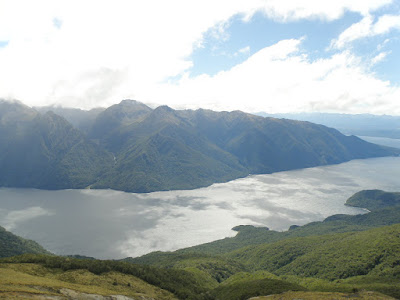
The Kepler Track is a 37-mile circular trail which passes from the lowland beech/podocarp forest to the alpine moss forest, to deep gorges with lake views. The track was named after Johannes Kepler, German astronomer famous for his laws of planetary motion. On a crisp blue afternoon i crossed a river and walked several miles through the dense/soggy forest to a campsite on the shores of Lake Manapouri. This was a spectacular area of Fiordland, with steep forested mountains plunging into the deep lake below. As I hiked into camp, I noticed a small hut and wandered in for a closer look. A friendly German guy was sitting inside and stated that there was plety of room for me to stay, which seemed be a perfect way to avoid a wet tent on the first night. As we closed mice holes in the floor boards with rocks, he stated that he was from the former East German Republic, (a place the allied military firebombed at the closure of WW2), known as Dresden. He related that he was traveling around New Zealand for 4 months, in an old beat-up van he purchased. its very popular to purchase used vehicles in New Zealand and resell them at the conclusion of their trip. New Zealand has no laws on importation of old cars and in fact no emission testing at all.


The sunset that evening left you with a feeling that the world is good and that you are exactly where you should be at that time. Dining on dehydrated curry chicken seemed extravagant after many days of PBJ sandwiches. We kept warm later that night by a fire, made by a New Foundland guy and his Quebecian girlfriend. They had the philosophy of bringing the kitchen sink, dining on steak, vegetable, wine and dessert. Everything was in place for a perfect evening, until the mosquitoes and sandflies invaded the hut (probably why everyone chose to set up tents). Corresponding with backcountry sharing he let me use his light, as mine had mysteriously disappeared. In the middle of the night I arranged an emergency tent setup, so the German guy (who I knew for 5 hours) and I snuggled in the tent happy to have survived the "mozzie" feast. For the record, this was my first experience sharing a tent with a strange man.


The next day we were met with skies so blue, no clouds seemed to have received an invitation. The Saxon and I climbed up the gradual slope discussing the bombing of Dresden, race relations in the U.S. south, and alternative forms of lifestyle. He was very typical German with strict orderliness, efficiency full tilt, and love of technological machines. He was an acoustic engineer, he loved camping from his mountain bike in his free time, cruising around NZ in order to improve his English.
Hiking though a pine forest we met a Brazilian, who had camped at the summit w/o a tent (to avoid the $15 dollar tariff) wearing 4 layers of clothing & nearly freezing to death, some people are just plain "bat-shit" crazy, I thought to myself. Amazing scenery was viewed up the iris burn valley to the next campsite next to a river. The Saxon & I parted ways as he was staying in the mountain hut.


As I prepared camp for the night and took some magic hour photos, a bedragled French men slumped into camp. He wore no shirt, and his pants hung a bit low around his waist. As he unloaded his Ramen noodles & white bread, he explained that his drawstring on his pants broke and his pants would fall down awkardly at times. Under his heavy French accent, he explained that he was from the Basque region in southwest France on the border with the Pyrennes. He had never been to Paris and that he recently finished his marketing degree, and planned to pick fruit for money as the season changed. I let the Frenchman use my cooker to heat his noodles, for a karmic repayment to backpacker code. That night after viewing 2 endangered blue ducks, I fell asleep to the sound of flowing water.


The next morning after a quick meal of white rice, the Frenchman & I ascended the Murchison Mountains. The warden had warned of winds of 100 km/hr which was going to be miserable, we thanked her for her kind words of encouragement and continued the climb. After 3 hours we reached the first emergency hut, I refueled with a cranberry snack, which provided nutrients for 1/3 of the day. The views of the fiords were astounding, although the winds did whip us around a bit. Luckily we received no rain and the sun beamed down on us as we wandered into the Mt Luxmore camp. We discussed many interesting things along the way, Basque independence movement, ethnic groups in France/Spain, & politics in Samoa.


The last section of the 10 hr downhill hike dragged on, but soon we were rewarded with panoramic views of broad bay campsite. There the Frenchman, Canadians & I enjoyed a well-deserved fully-clothed rest on the beach. Since the French guy was the only one crazy enough to go into the frigid waters, he was induced to procure everyone fresh water. The last night I passed out by 8 o'clock, feeling deeply satisfied. The last day of tramping brought me back to Te Anau, where I cleaned up, had some lamb Vindaloo, and sampled local brews. The next day I took a 12 hr bus ride back to Christchurch and civilization. I knew I was back when a red-headed Englishman next to me played loud metal music with no consideration for his surroundings. Ah the trappings of the modern world.

2.13.2010

Against the Wind


Anytime a natural disaster is imminent, people go into survival mode. They exaggerate, make outlandish statements, or hide in their basements as if under aerial bombardment. This survivalist tendency (while having an organic etiology) is stoked by the media, which elevates the fear factor, this is what we call "good business." I figured you can't live in the south pacific for over a year without experiencing a cyclone, so i went along for the ride. Our neighbors were boarding up their houses, local stores were packed with people stocking up on last minute goods, people had fear on their lips. Granted a life-shattering tsunami occured a few months back which helped shape the current environment of hysteria. I stayed glued to the radio, brought in my motorcycle, outdoor bench, and grill & fantasized about a tree slamming into our large windows facing the ocean.

Tropical cyclone Rene formed off the coast of the northern cook islands (east of us) and was gradually increasing in intensity as it headed toward the Samoan islands. It was classified originally as a tropical storm until it was upgraded to a category 1 hurricane, expected winds of 74-95mph & surf 15-20 feet. By Friday the hysteria was thicker than molasses, with a bulletin by the governor stating we should secure life and property, stock up on emergency items, board up houses, & not venture outside. Red cross workers were put on high alert, ready to swoop in following the path of the destruction. People could be heard on the radio, saying "we're in gods hands", "we're due for a direct hit", all signs point to the "big one." So i waited, munching on popcorn for the blockbuster film called Rene.


The term "cyclone" refers to such storms' cyclonic nature, with counterclockwise rotation in the Northern Hemisphere and clockwise rotation in the Southern Hemisphere. Depending on its location and strength, a tropical cyclone is referred to by names such as hurricane, typhoon, tropical storm, cyclonic storm, tropical depression, and simply cyclone. The naming of cyclones follows a series of set lists, numerous regions/countries have their own lists: north Atlantic, Australia, Philippines, Indonesia, Indian ocean, japan, etc. For the Samoa archipelago, we used the southwest pacific ocean system, list B, number 17#- Rene. These lists usually alternate genders and follow the roman alphabet, with Greek letters for additions. Also, the classification system of strength varies from tropical storm to category 5.

Each update by the national weather service placed the land-fall of the cyclone later and later, moved from 12pm to 4am, finally no cyclone. The truth be told, we experienced high winds, with gusts around 50mph. My internal cyclone radar clocked it as weak, as we slept through most of the night. The next morning driving to work i thought about the hysteria that the media preys upon. True, knowing a big storm is coming can protect lives, yet many times the media go way beyond this. Why? Because like it or not the modern media is a corporation driven solely by profits, scaring the hell out of people makes people stay tuned.

At a certain point, due to the annoying music & lethargy from scare tactics, i shut off the radio and just listened to the wind. Having no T.V., we are shielded from much of the culture of fear, but it still leaks through. Anyway, I'm sure you can think of many examples of the media exaggerating things (war, health, crime)- maybe next time you can just shut it off, and listen to the wind.

1.08.2010

Quid Pro Who?

Reciprocity is a way of defining people's informal exchange of goods and labour; that is, people's informal economic systems. It is the basis of most non-market economies.

Turning back the clock, we would all find ourselves living as hunter-gatherers at some point. This way of life focused on a system of exchange that predated even barter and trade. People were typically involved in a gift giving economy, where goods and services are regularly given without any explicit agreement on rewards. Simultaneous and recurring gift giving serves to circulate and redistribute any valuables within the community.

We find many modern day examples of the gift economy, particularly in the Pacific Region:

Native Americans Pacific Northwest Tribes potlatch (meaning gift), where one commnunity invites another to a huge feast, with the main purpose of the redistribution or reciprocity of wealth.
New Zealand Maori koha (gift),gift giving by visitors to a host, traditionally involving food or a tresured possession.
Papua New Guinea moka, big men (local leaders) are involved in complex exchange of pigs and sweet potatoes which serves to elevate prestige.
South African Bushmen- ecomonomy based on gift giving instead of trade or purchasing goods
SouthEast Asia Buddhists- feasts of merit, similar to potlatch and occurs after the rainy season.

The concept of Fa'a Samoa or "The Samoan Way" is the fabric that glues the traditional society here together. Each person has a clearly defined relationship to another in the extended family, which is orchestrated by a matai or chief. Certain cultural mores or taboos are enforced via this network and it is one of the first lessons learned by a palagi. At first glance an outsider may view these proceedings as strange, odd, or even corrupt on a certain level. The sooner one comes to accept these laws of the land, the smoother their transition or stay will be.

One of the chief tenets of Fa'a Samoa is reciprocity, or more clearly defined by cultural anthropologists as balanced reciprocity. One look no further than the elaborate feasts that Samoans hold called Fa'alavelaves (any event where the extended family gathers together), usually held for weddings and funerals. The matai or chief of the family solicits funds from the extended family, which can be a considerable amount. In addition to hard cash, they may arrange for canned fish, fine mats, and other items to be included. The family members arrive at the gathering, where elaborate rituals, dancing, talking chief speeches are taking place. In exchange, 1/2 of the money or gifts may be returned, the visitor given food for more than one sitting (take home bag necessary). Others will be pressured to have a more elaboarate faalavelave and thus the cycle continues. Unfortunately, in modern day society the sums of money are huge, corruption, excessive family pressure, and virtual extortion of off-island members can taint the pureness of the practice.

Reciprocity extendes its tentacles into virtaully every fabirc of Samoan society.
One need only spend an afternoon in Samoa, before you start to scratch your head and wonder, what the hell is going on here? Doors are locked, people not available, normal everday items sold out. This facade will drive the average person crazy until you rip away the curtain and expose an ordinary man behind the curtain, The Samoan Way. At first many sneer at this system, describing it as corrupt or unfair, but sooner or later they will be involved in paybacks.

My first in depth encounter with Fa'a Samoa, occured down at the shipping container yard, where our car had arrived from California. Excited at the prospect of transportation after sharing a hospital vehicle for the past few months, we were met by a stiff lipped receptionist, who stated that indeed our shipping container had arrived and no we could not have our car today. We were handed numerous forms, which we had to conduct a virtual scavenger hunt (nobody was where they were supposed to be) to complete. Confident in our completion, we returned to the yard later that week. The next move in the chess match had to do with bargaining. A little known fact is that the American Samoa government collects 10% of the blue book value of your car upon arrival. Rook to knight, our car was a junker, after a few minutes of negotiating, we handed over 50 bucks. Sorry, but you will have to return after the weekend, as we will need to process the paperwork. The next monday, we were stonewalled, as they told us a visiting cruise ship had closed the shipping yard and customs.

At this point we decided to come in through the back door, local style. Our new landlord happened to be the manager down at the stevedoring company. When we cruised in with him, the tight lips became smiles, the no becomes yes, and closed was indeed open for business. We went through the backworkings of the customs building, into a room with (no lie) at least 10 customs officers, with feet kicked up, eating breadfuit and smoking under the constant hum of the aircon unit. The motherlode, we had the key which now fit the keyhole; of course we could have are car inspected today. With a few waves of the hand our container was unloded from the stack, pried open, and 1 sweet 1997 ford taurus sedan, complete with cracked windshiled and smashed in r side rolled off the palate. The customs officer said "you sent this thing across the pacific" everyone laughed as we pulled out less than 3 hours later.

After a while, you don't even notice when a police officer pulls you over, you conveniently mention that you work at the hospital, and the next monday he is sitting in your office explaining that he is constipated. Or, that your neighboorhood store drives your empty scuba tanks across island to be filled, which you repay with a chocolate cake all around. Or you help load crates of beer on a motor boat and find that your fare has gone down to zero. Bring food anywhere and like it or not you may have friends for life.

The most recent episode of The Samoan Way, happened as a result of a drivers license citation I received in a holiday weekend roadblock. The cop asked if I had a local license, which is not valid on the mainland, at which I said no. Having been on island more than 3 months, I was given a citation and told I needed to appear in court and obtain a local license. My first attempt to dial into the system was busy, as i went down to the court house to ask a favor from a judge that was a patient of mine. He denies my access, as he reiterated that that was the law, informed me of the course of action, and even flagged me down in the parking lot to tell me to bring my passport to court. Arghh! My next dial in was accidental, almost a wrong number. The clerk at the court house, where I was obtaining a sercuity clearance, asked if I worked at the hospital. Looking down at my scrubs, I stated yes I do, yes I do. Do you know Dr. X., of course we go way back, well in that case why don't you just pay a fine and get the license later, scouts honor style. I almost fell over laughing, when the clerk suggested that I just pay $10 dollars instead of the required $60. Attention, we have a green light! One can easily see how relative law in general is especially when someone picks up on the other end of the Fa'a Samoa batline.

Of course traditional mechanisms for control break down from the onslaught of modernization, rapid corruption sinks its teeth in. Intense prssure is exerted on individuals and families to pay to the chief of a village for a fa'a lavelave, funeral, or festival. When governments become involved, just like in many backwaters in the world, kickbacks are handed out. This corruption has many of the current administration under indictment or investigation. Living in a small community in the south pacific, lives up to the phrase, it's who you know.

“Nothing can cure the soul but the senses, just as nothing can cure the senses but the soul.” Oscar Wilde

12.30.2009

The Cannibal Isles


The Fijian archipelago, consists of 322 mountainous islands of volcanic origin. In the past, these islands were known as the cannibal islands (although documentation is scarce) and were avoided by sailors due to treacherous waters and fierce warriors. The industries are tourism, sugar, clothing, copra, gold, silver, lumber, and small cottage industries. Although located in Melanesia (black islands), the demographics reflect 54.3% indigenous Fijian, 38.1% Indian (from India), and 1.2% Polynesian. The Indians were brought to Fiji as indentured servants to toil away in the sugar cane fields. As they weren't allowed to own land, they evolved into shop keepers, business people, and money lenders. The current political landscape has been marked by several military coup d'etat (1998, 1998, 2000, 2006), as native Fijians fear the encroachment of Indo-Fijians into their traditional sphere of influence. As a result, many Indo-Fijians have returned to India for safety reasons. The 2 major ethnic communities are further divided by religion (christianity vs hinduism) and language (fijian vs hindi).


Aside from the recent political turmoil, The Republic of Fiji is blessed with amazing scenery above and below the water. Home to some of the most spectacular coral reefs in the world, we planed to travel to the outer islands and "walk on the moon". In the northwest corner of the archiplego, between the islands of Vanua Levu and Taveuni lies the Somosomo strait. Fed by nutrients that emerge from the depths of the Tongan trench, rainbow reef is world famous for its multitude of reef fish and soft corals. The trademark or signature species in the area is the soft coral, which billows and undulates in the currents. The soft coral comes in dramatic, often electric hues of orange, red, pink, and white-fringed by purple. The visiblity is typically around 40 meters, making the diving similar to an aquarium.


This trip differed from our normal wilderness expeditions due to the fact that we were staying at an eco-resort. This was necessary for several reasons, mainly due to accessing the reefs. Although Fiji is less than 2 horus from Samoa you would think that getting there would be a breeze. In actuality, we had to take a 30 minute puddle jumper plane to western samoa, then take an overnight light into Nadi, Fiji. No comment on the city area of Nadi, as urban centers were not the focus of this trip. After crashing at Mama's place, we boarded our 15 seater plane for Matei, Taveuni nearly 2 1/2 hours late. At the airport, after listing the plane as delayed, our flight was taken off the board, with new boarding schedule as "pacific time" or whenever. I noticed the planes' right tire was 2/3 full and the left was completely bald as we taxied down the runway. Although expecting a crash landing, we safely touched down onto the "garden isle" as Taveuni is known due to its abundant flora.


We were met by a wild-eyed 1/2 German dude and a straight laced Indo-fijian who took us to the dock for a 40-minute crossing of the strait. The German explained that he was Silesian, which as a result of World War II and the redrawing of political boundaries, he was a German and Polish citizen - which sounded like a great place to come from if you're a secret agent. We boarded the aluminum boat and roared full-throttle across the pounding waves of the strait. As usual the boat driver said the rough waves were nothing. On the website Dolphin Bay Divers Retreat sounded remote, describing itself as without roads, disco, or electricity. As we approached a sandy cove of the south of Vanua Levu, I saw no roads or disco, yet also no resort. Immediate paranoia set in, as i thought we could be on the menu, until i noticed a smiling Fijian lady come out of the rainforest. She was a documented smiler, as she later showed us a Book of Smiles with her picture in it.


We were introduced to our hosts, a wonderful lady from germany who ran the retreat and her partner from switzerland who operated the dive shop. Our bure was constructed of bamboo and corrugate, and located a stones throw from the ocean. The host said not to worry about the paper work, just relax. Note to self- we had truly entered the garden of eden. To our surprise there were solar powered lights during the day and a generator in the morning and evening hours. We were free to enjoy heaven, except for a few simple rules. The brown dog could not be petted, the 7 cats could not be fed, yet the white bog named socks was fair game for anything. The retreat was in the middle of nowhere, but run with german efficiency. We spent the first evening meeting the other guests, and drinking Fijian bitter beer.


The other clientele were reminiscent of the casts of a television show. There was a semi gay Swiss man, who was traveling with an Indian guy from Australia. The swiss guy was famous for yelling obscenities in English, out of context and for seemingly no reason at all. The first time i met the Austrlaian guy i thought he was mentally retarded, michelle thought he had too many drinks. We were both wrong, as this was his normal persona, which included walking up to you and identifying his name and where he was from in a thick Australian accent, although he grew up in India&England. He would sing songs into the night, accompanied by one of the dive masters who played guitar. He would ask you to visit him or tell you when he was coming to your home for a visit -- the day he left we breathed a sigh of relief. There was the 1/2 german who had come to the island for an undetermined amount of time, to do undetermined things, as he recently received an inheritance (German spy anyone?). There was an angry German man, who reminded me of a prussian general, who had dived over 10,000 times and had done everything known to man. There was a California blond, who had a sushi roll named after her and believed you could pick wild oranges from any tree in California. A Cardiology medical student, who instantly attended to anyone complaining of sniffles or sore muscles. This collection of characters spent christmas together on a remote, small island in the south pacific.


Adhering to German time standards, at exactly 7:15am each morning the generator would snap into action, which was the signal for the start of the day. We would stroll over to the dive shop, organize our gear, and sit down for a breakfast of brewed coffee, fresh fruit, and toast. My only complaint (which being American Im entitled to at least one) revolved around the family style seating, where every meal was shared at a communal table. This sounds organic and wonderful, until the Australian man started bellowing an Indian love song and the Swiss man commences to belt out obscenities at awkard moments. In hindsight it was interesting to meet such a strange cast of characters and learn about their lives.


Around 8am, the dive boat would pull out and we would discuss the dive plan for the day. Depending on the currents, weather, and who was diving a suitable site would be discussed en route. Boat dives are a bit different from land dives, which we had been doing in Samoa. Each person has a partner, who simultaneously backrolls with you off the boat into the water, and you rendezvous before descending. Usually, there are 4-5 divers and 2 dive masters, who know the reef and its inhabitants. The first dive was a bit of a shock as the current was excessively strong, blowing the divers down the reef, meeting up at the bottom was difficult, as we all had to hang onto the various hard corals to keep from being blown away. My first glimpse of the reef was memorable, as the visibility was amazing and the colors of the reef reminiscent of a district of neon signs. After re-grouping, we changed directions in order to follow the current. After 45 minutes of interstellar moonwalking, we surfaced and reboarded the boat, many sustaining deep cuts and bruises. The Prussian General sustained the worse injries, and stated that he had never been in such a strong diving current. To pass the time during the hour wait on the surface in order to avoid nitrogen building up in the bloodstream, we drank tea and ate biscuits and discussed the dive plan for the 2nd dive.


When first learning to dive the underwater world seems supernatural, yet as you return to the ocean depths, things become more familiar, and as humans we begin to categorize. The most difficult thing for new divers is learning buoyancy. Each diver wears a weight belt to help them sink, and regulate their depth with their BCD or Bouyancy Control Device, which has 2 buttons for ascending/descending. Depending on how deep you go, a mandatory safety stop occurs before surfacing, lasting from 3-5 minutes. This is based on mathematical formulas, to keep you from getting The Bends (joint pain) or a condition arising from the precipitation of dissolved gasses into bubbles inside the body on depressurisation. Its effects may vary from joint pain and rashes, to paralysis and death If you do get the bends, you must be taken immediately to a re-compression chamber, and the nearest one to rainbow reef was a 2 hour flight to the main island of Vitu Liti.


The week was filled with artistically named dive sites called: The Zoo, Rainbow End, The White Wall, Jerry's Jelly, The Edge, Annie's Bommies, Cabbage Patch, Fish Factory, ect. The aquarium was filled with white tip & black tip reef sharks, which are typically smaller and less aggressive types of sharks (divers are generally more agressive). Other larger species included green turtles, spotted sting rays, baarcuda schools, Picasso triggerfish, Moorish Idol, Anemones, etc. The geography of the dives ranged from pure drift dives (where the boat drops you off at one end and you basically float on the current to the other end), caves and tunnel dives, hard coral and soft coral walls. Like a choreographed dance, the weather was sunny and brilliant each dive, wind was minimal, vibility 40 meters, water temperatures around 29 degreees celcius.


After diving we would clean the gear with fresh water, as salt water is extremely corrosive. Have lunch, which could include a freshly caught fish from the local fisherman. Followed by reading and nap time, the amount of energy spent diving makes even the most energetic spaz take a snooze. Communal dinners were in the open air with beach view. The Swiss Dive Operator and I spent many a night talking about Polynesian, Africa and south East Asian adventures, politics, and religion. for such a remote location and limited electricity, the bungalows were comfortable, spotless, and the food excellent. They even have a wine list, to share boozy evenings with fellow divers swapping fish stories. Being a closet romantic, I arranged for a candle lit dinner for 2 on the the beach with a bottle of red. We laughed away the evening as the tide creeped under the table.


The valley where the retreat was located had an arid micro-climate, where little rainfall occured. They told us that a cyclone had come through last week and brought a bit of rain, if not they would have been switching to bucket showers. On all toilets the slogan- "if its yellow stay mellow & if its brown flush it down" got to the point of water conservation. The organization of the retreat had Fijian women working in the kitchen and cleaning rooms, Fijian men as dive masters and boatsmen, Tuvaluan as groundskeepers, and Indians as taxi drivers to/from airport. Tuvalu is a small coral atoll in the south pacfifc, which may be one of the first victims of global warming. As a result of the threat, they bought an island in Fiji and moved 12,00 people to Kaio near the rainbow reef.


Mid-week, we decided to experience some of the beauty of Taveuni above the water line. Early one morning, we crossed the Somosomo strait and traveled north through the greenery of Taveuni. The only drawback was dropping the Australian at the airport, where he gave us his information and said before we came to visit, to write him an email about where we met, who we where, and the circumstances. We both laughed about how many people this poor soul had accosted during his aggressive traveling campaign. We were headed to the secluded Lavena Coast within Bouma National Park. The guide looked a bit disappointed as we asked him to cover us for the entrance fee and that we liked to hike alone. A 4km windy path took us along a rocky coast, with secluded sandy coves, suspension bridges, and a sleeping banded coral snake that we almost stepped on (it had been sunning itself). At the end of the magical walk, we reached a stunning display of beauty, including two intersecting waterfalls leading to a crystal clear river. We had to wade a small distance upriver to the base of these majestic falls. When in Rome I thought, as I climbed the smaller falls and commenced the time honored rock slide into a pool below. Great blue herons flew overhead and time stood still. Why more people can't appreciate nature is inconceivable to me. It's always right in front of us, beckoning us to come home. At times we feel as if we're seeing things that the next generation cannot comprehend. There's something deeply satisfying about doing the dead man float in a pool under the convergence of 2 waterfalls on a sunny day. I had succumbed to the euphoric powers of the fiji tourism moniker that states: FIJI ME.


Upon our return to Dolphin Bay, the hostess suggested that we may want to spend Christmas in the next bay over where they manage an upscale resort for a California couple. I stated that we prefered our bure, and when she said that we could transfer for 3 days, 2 nights at the same price i sold out, and it was phenomenal. The rainbow reef resort had handcrafted bungalows perched on a white-sand beach: large front porch, comfortable family room, outdoor bamboo shower, ornate bedroom, we were spoiled on christmas. Im a big believer, like many americans, in free stuff or perks.


Following the conclusion of Christmas dinner (cooked in underground lovo oven) we sat on fine mats underneath the stars in a circle. Guitar music filled the background, as flying foxes swooped underneath the southern cross. In the center was the kava master of ceremonies and a large handcarved bowl of muddy colored water, before us was a 1/2 coconut sheel called a "bilo." Kava is sedating and is primarily consumed to relax without disrupting mental clarity. Its active ingredients are called kavalactones. In some parts of the Western World, kava extract is marketed as herbal medicine against stress, insomnia, and anxiety. Fijians call it "grog", due to its relaxing and groggy effects on the drinker, made by pounding sun-dried kava root into a fine powder, straining and mixing it with cold water. when the Kava master fills your cup, he asks "high tide or low tide" (small or large), you say bula and clap 2 times, followed by everyone chanting bula and clapping. Bula is a word that you hear more than any other in Fiji. It can mean hello, welcome, or even exclaimed when you sneeze. It means life and is a way of saying good health to the recipient. By the end of the 800th round, we were all laying supine and singing songs like west virginia, buffalo soldier, and many fijian songs we didn't know the words to.


The last few days we lazed on our private beach deck, snorkeled, and hiked through the extensive trail network in the hills surrounding the resort. With only 2 other groups, the resort was more like a wealthy person's house that we were squatting in for a few days. The Prussian general's girlfriend had arrived, and a swiss souple working for the international red cross were our distant neighboors. After many sedating afternoons reading books: Paul Farmer in Haiti, The Sushi Revolution, and Ann Raynd cult classic Fountainhead our time in the garden of eden was coming to a close. The whole staff including the owners presented us with symbolic beads and sang us a farewell song. As we crossed the Somosomo strait one last time, we felt like we were returning from some strange planet. Im still not a resort kind of guy, but Dolphin Bay Divers is a special place, truly a retreat from the world.


While waiting for our red-eye flight back to samoa, somebody came up and said "hey doc you headed back to pago?". You know you live in a small place when 2 countries over someone recognizes you and wants to share a taxi when you get back. After arriving back in Samoa, we split the fare to transfer airports. He and his wife stated that they had spent a week shopping in the 2 largest cities on the main island and were disappointed. When asked about our experience we stated " it was ok," at which the man replied "there's nothing like pago though right doc". We arrived at the airport at 4am, which had no lights and the guard had to let us in. We shared 4 slabs on concrete for the next 3 hours with an old solo Italian lady, who had visited 235 countries, and 3 guys from Vanuatu who had never left their small islands. They had been on 4 flights (their first flying experience), and were headed to pago to work on the fishing vessels for 2 years. We helped them with their immigration papers and called their company to notify them of their arrival. Imagine the culture shock for these guys who had never met an American before, let alone an American Samoan. Our car was not towed from the airport, started without trouble, and our house was not broken into during our vacation. All in all it was a great excursion into the Melanisian crossroads of Fiji.